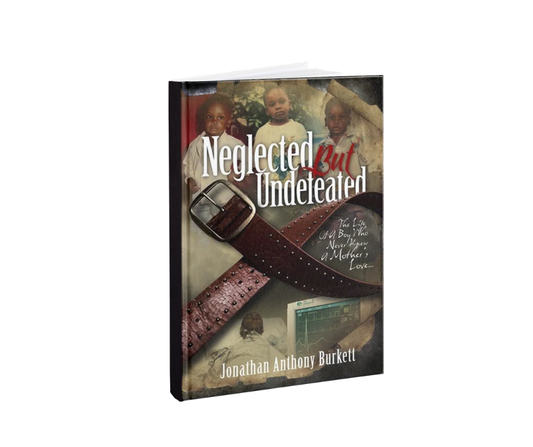
By Jonathan Anthony Burkett
A reflection drawn from my autobiography, Neglected But Undefeated.
A place for what I could not say
Before Neglected But Undefeated became a book, writing was a much smaller and more private act. It was a way to put feelings somewhere when speaking them felt difficult. In the memoir, I describe writing poetry, keeping thoughts on paper, and returning to a notebook during unsettled periods of my life. I was not beginning with a publishing strategy. I was trying to find words that could hold an experience long enough for me to look at it.
A notebook did not change everything around me. It did not provide a home, resolve every relationship, or answer every question. What it offered was room to complete a thought. On a page, I could describe anger without needing someone to interrupt it, and admit longing without immediately disguising it as a joke. Sometimes the language was rough. The important beginning was that the feeling had become something I could examine, rather than something I only carried.
That distinction remains useful to me when I think about voice. A voice is not simply a recognizable style or a polished sentence. It also involves deciding what you are willing to name accurately. What happened? What did you believe at the time? What remains uncertain? Writing becomes more trustworthy when it makes those differences visible. The page can hold an unfinished understanding without forcing the writer to pretend that every event already has a satisfying explanation.
Learning that words could reach me
In my autobiography, I name Maya Angelou as an important influence on my interest in poetry and writing. Reading another person's words helped me recognize that language could reach feelings that ordinary conversation sometimes passed over. I am describing the effect her work had on me, rather than claiming that our experiences were identical. A reader can feel a connection across very different lives because a writer has taken the trouble to express something carefully.
My own early pages did not have to sound like anyone else's work to matter. Admiration can open a door without becoming an instruction to imitate. There is a difference between learning that a poem can be honest and copying the language that made another poem powerful. The first can encourage a writer to pay closer attention to their own experience. The second can prevent that attention by supplying an answer before the real question has been explored.
I also remember a strong result on a school writing test that gave me reason to take this ability seriously. Encouragement does not always arrive as a grand prediction about somebody's future. Sometimes it is a moment in which a person recognizes that something they have been doing privately has value outside their own room. That recognition does not finish the work. It can make the next attempt feel worth making.
From a feeling to a piece of writing
A private page and a public article have different responsibilities. A private page can contain everything in the order it arrives. A reader needs enough structure to follow why those details matter. Turning experience into writing therefore requires another kind of attention: deciding what belongs in this particular piece, which background is necessary, and where a feeling has been expressed clearly enough that repeating it will add little.
One practical beginning is to choose a single question. A whole childhood will not fit honestly into every article. A question about belonging, friendship, grief, or keeping a promise gives a piece a direction. The writer can then select a relevant moment and stay with its meaning. That selection should make the story clearer, rather than force the memory to support a lesson it does not actually contain. Some experiences remain complicated even after careful reflection.
Revising also means separating what I remember from what I later learned. A childhood interpretation can be important without being the final explanation of an event. I may describe how something felt at the time and then acknowledge that I did not understand everything around me. That admission does not weaken a personal story. It lets the reader see the person who lived through it and the person who is now trying to tell it responsibly.
An invitation rather than a formula
I would not tell another person that they must publish their pain to become a writer. Privacy is a legitimate choice, and a notebook does not owe the world its contents. Someone may write to clarify a decision, preserve a memory, thank a relative, or explore an imagined character. Those purposes deserve respect even if the pages never become a product. The value of writing cannot be measured only by the size of its audience.
Nor would I promise that journaling will solve a health problem. My account describes what writing meant within my life, alongside many other experiences and forms of support. It is not a substitute for help that a person may need. The more modest invitation is to consider whether a few honest sentences could make one thought easier to understand. A small beginning can be worthwhile without being advertised as a complete transformation.
For a person unsure where to begin, an ordinary detail may be more useful than a sweeping declaration. Describe a room you remember, a journey you took often, or a conversation that left you with a question. Then ask what you knew at that moment and what you understand differently now. There is no need to make the first version impressive. Give the detail enough attention to discover whether it contains something you want to explore further.
The distance between a notebook and a finished book includes work that a reader may never see. There are decisions about language, boundaries, sequence, and what can be left unsaid. I want the writing I share to help another person feel recognized without pretending that our lives are interchangeable. That aim began with the simple act of putting words on a page. Before there was a book, there was an effort to say something true.
Read Neglected But Undefeated, explore my books and more of my quotes.
#upstormed #jonathananthonyburkett #jonathanburkett #NeglectedButUndefeated #WritingLife
Comments
Post a Comment