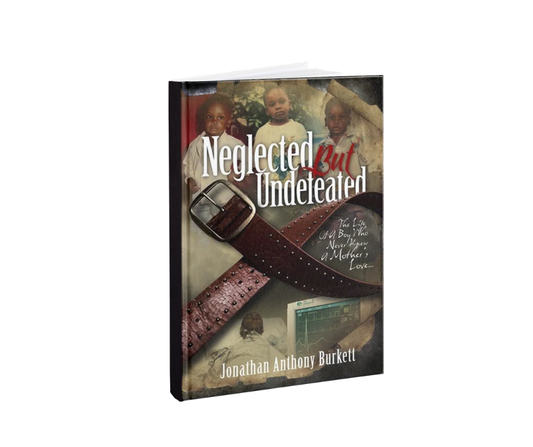
By Jonathan Anthony Burkett
A reflection drawn from my autobiography, Neglected But Undefeated.
Love with a particular face
When I describe the reasons I kept looking toward a future in Neglected But Undefeated, my younger brothers return again and again. They are not an incidental detail added to make the story warmer. My love for them is part of its structure. During periods when my own direction felt uncertain, I could still imagine wanting something good for them. Their presence gave the future a particular face and made the consequences of my choices feel less abstract.
The book remembers ordinary moments alongside difficult ones: playing together, being asked for help, sharing a room, and laughing over small acts of mischief. These memories matter because family life is not made only of major decisions. An everyday request can reveal how much one person trusts another. A child asking an older brother to help with a simple task may see only the task. For the older brother, that moment can also be a reminder that his presence has meaning.
I wanted my brothers to have a childhood in which they felt loved. That wish was connected to what I knew about wanting reassurance and not always knowing where to find it. A personal history can sharpen our awareness of something another person needs. It does not automatically make us perfect at providing it. The useful question is whether that awareness changes our behavior in a way the other person can actually experience.
The care that moved in both directions
It is easy to tell a family story as though help always travels from older people to younger people. My account is more complicated. In the acknowledgments, I thank my brothers for helping me with food, a shower, shelter, and somewhere to rest during unstable periods. They had limited power over the circumstances, but the kindness they could offer was real. Remembering it prevents me from describing love only as something I gave to them.
Gratitude is more accurate when it names what another person did without making the action larger or smaller than it was. A meal is a meal, and a place to rest is a place to rest. Neither should be dismissed because it did not solve everything. A person in difficulty may remember practical help with great clarity precisely because it met a need that day. The memory can remain meaningful long after the immediate problem has changed.
At the same time, children should not be expected to carry responsibility for an older person's survival or stability. My gratitude to my brothers does not make that burden theirs. A story about what happened is different from a model of what should be required. Adults, services, and wider communities have responsibilities that affection between siblings cannot replace. It is possible to honor a child's kindness while still recognizing the limits that should protect their childhood.
Wanting a different pattern
Love for family can give a person a reason to interrupt a pattern they do not want to continue. In the memoir, I repeatedly consider how my actions could affect my brothers. I want to be present for them, and I want their lives to contain opportunities for happiness. Those wishes do not erase the anger and uncertainty described elsewhere in the book. They show that a person can hold conflicting feelings while still having a relationship that calls them toward greater care.
The idea of changing a family pattern can sound enormous. In daily life, it becomes more specific. It may involve explaining a decision instead of expecting someone to guess, returning to a conversation after cooling down, or acknowledging a mistake without making the other person responsible for comforting you. These are reflections on ordinary conduct. They are not a claim that every family difficulty can be resolved through a better conversation or a little more patience.
Some circumstances require boundaries, distance, or help beyond a household. Care should not demand that someone accept harm to prove loyalty. A dependable family relationship gives people room to have needs and limits. When I think about the kind of family life I want to help create, I think about affection that can be recognized in practical behavior. Love becomes more credible when it does not disappear the moment somebody asks an inconvenient question.
What being there can mean
Being there is a phrase people use easily. Its meaning becomes clearer when it describes something observable. A sibling answers a message, remembers an important date, makes time to listen, or says honestly when they cannot help. An accurate limit can be more dependable than a generous promise that never becomes an action. Relationships need room for both affection and truthful information about what each person can actually offer.
It also matters to let family members grow beyond the roles we remember. A younger brother will not remain the same child who once asked for help. He will develop opinions, responsibilities, friendships, and a life of his own. Loving someone includes making room to learn who they are becoming. The book records a period in our history. It does not entitle me, or a reader, to assume every detail about our present lives from those memories.
That is one reason I want to speak carefully when sharing family stories. A memory can explain what a relationship meant to me without making every relative's private life public. Gratitude does not require disclosing every detail. Sometimes a truthful account of care is enough: they helped me, I loved them, and their presence mattered. A reader can understand the significance without being invited into circumstances that do not belong to the article.
My brothers helped keep a place in my future when I struggled to imagine it for myself. The lasting lesson I draw from that love is an obligation to pay attention to the people beside me and to the effect my choices have on them. Family can be a reason to keep building, learning, and becoming more responsible. It can also remind us that we have received care worth acknowledging, and that the next act of care can begin in an ordinary moment.
Read Neglected But Undefeated, explore my books and more of my quotes.
#upstormed #jonathananthonyburkett #jonathanburkett #NeglectedButUndefeated #FamilyLove
Comments
Post a Comment